
Ditch Relief Culverts
A ditch relief culvert (DRC) is a plastic, metal, or concrete pipe installed beneath the road surface to convey flow from an inside road ditch to an area beyond the outer edge of the road fill. When properly spaced, DRCs limit the quantity of water available to cause erosion at any single location, allowing flow to disperse and reducing the likelihood of gullies forming at their outlets. It is sometimes necessary to install downspouts or rock armor at DRC outlets to further dissipate energy and prevent erosion.
Considerations when installing ditch relief culverts:
- Ditch relief culverts should be installed sufficiently before watercourse crossings so that water and sediment can be filtered through a vegetated slope before reaching the stream.
- Ditch relief culverts should be installed at intervals along the road that are close enough to prevent significant erosion of the ditch and below the culvert outfall on the native hillslope.
- Ditch relief culverts should be installed at locations where collected water and sediment is not discharged directly onto unstable areas or into watercourses.

Examples of inadequate ditch relief culvert frequency

Two extremely large gullies formed entirely by long lengths of road draining to a ditch relief culvert. The gullies formed in succession, from right to left, as the landowner moved the location of the culvert when the road was beginning to be threatened by undercutting at each site.
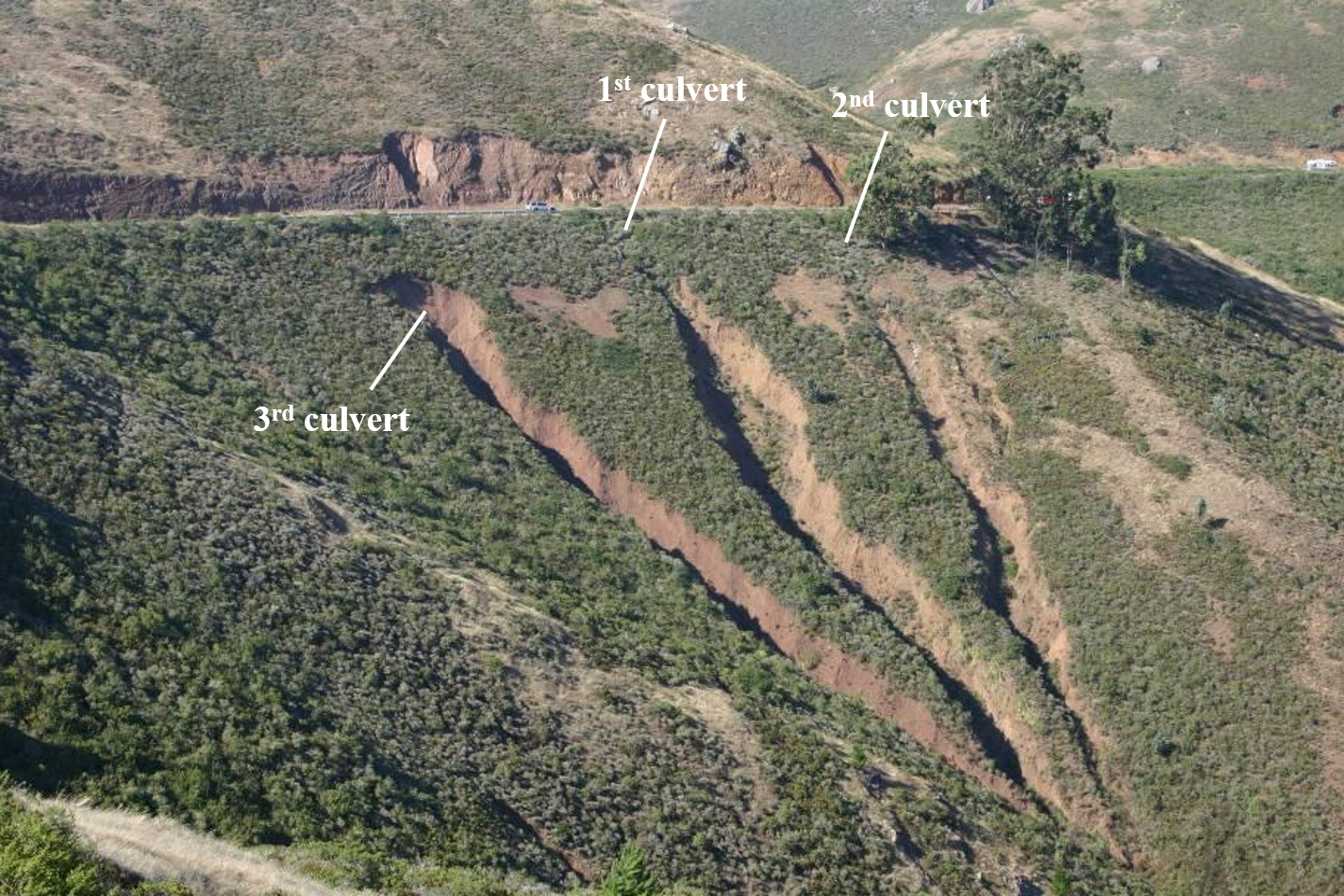
A third extremely large gully formed entirely by long lengths of road draining to a ditch relief culvert. These erosional processes can be prevented by increasing drainage structure frequency to disperse road runoff, so there is never enough flow to cause significant rilling or gullying.
Examples of techniques to reduce outlet erosion

A ditch relief culvert being installed. Culverts shall be installed at a 30 degree angle to the ditch with minimum 10 percent fall to lessen the chance of inlet erosion and plugging.

A ditch relief culvert that was not able to be installed at the base of fill, has energy dissipation (rock armor) installed at the outlet to reduce erosion potential.

A full round downspout attached to the outlet of a ditch relief culvert to reduce erosion potential on the steep outboard fillslope. Downspouts can be attached where installing the ditch relief culvert at the base of fill is not feasible.
What should I do about ditch relief culvert problems?
- Contact the Marin RCD: call, email, or use the submission form in the sidebar of this page.
- Secure permits. Permits may or may not be required to address ditch relief culvert problems depending on the project.